



Role of SCADA in Electrical Testing & Commissioning at Site
The Role of SCADA in Electrical Testing & Commissioning at Site is not limited to visualization—it is a high-level validation and diagnostic system that ensures complete operational readiness.
The major Role of SCADA in Electrical Testing & Commissioning at Site is critical for validating signals, protocols, and automation workflows.
In real-world SCADA System Integration and plc scada system integration projects, SCADA acts as the central verification platform where all field-level signals, communication protocols, and control logic converge.
In electrical substation automation, commissioning without SCADA validation is equivalent to energizing a system without full visibility.
SCADA as the Final Validation Layer
The Role of SCADA in Electrical Testing & Commissioning at Site begins at the final stages of installation, where SCADA validates:
End-to-end signal flow:
SCADA ensures that signals generated at the field level (from relays, sensors, or IEDs) are accurately transmitted, processed, and displayed at the control room without any loss or distortion.
Real-time data consistency:
It continuously validates that the data shown on the HMI matches actual field conditions, ensuring operators can rely on accurate, up-to-date information for decision-making.
Device interoperability:
SCADA enables seamless communication between multiple devices from different vendors by integrating various protocols, ensuring all components in the substation automation system work together efficiently.
Unlike PLC-level checks, SCADA(supervisory control and data acquisition) verifies system-wide behaviour, especially in substation automation systems where multiple IEDs and protocols interact.
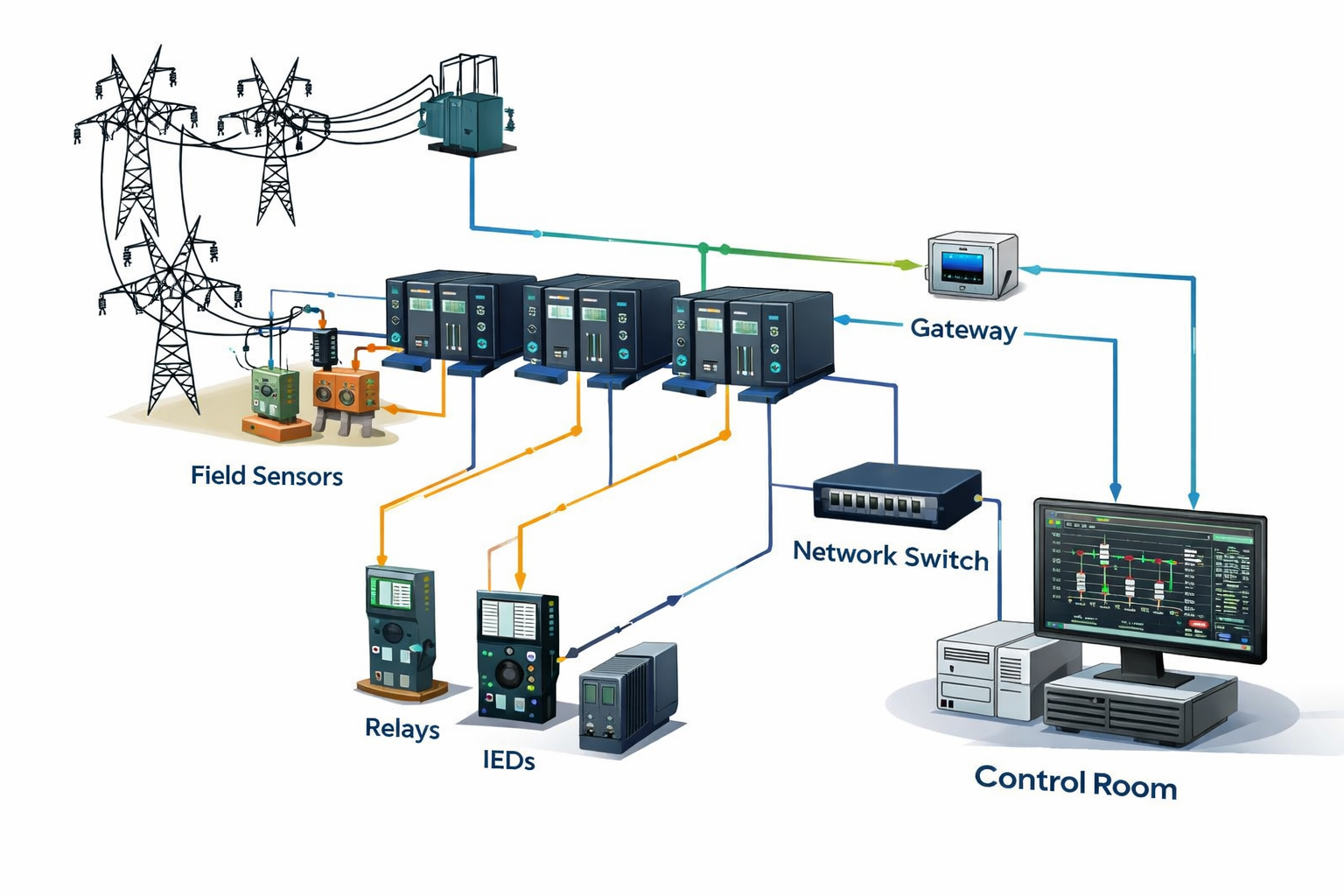
SCADA system diagram for monitoring
Deep Dive: Signal Mapping & Database Integrity
Signal Mapping:
Signal mapping ensures that every field signal (DI/DO/AI/AO) is correctly linked to its corresponding SCADA tag for accurate monitoring and control. Any mismatch in mapping can lead to incorrect indications or unsafe operations during electrical testing & commissioning.
Database Integrity:
Database integrity ensures that all SCADA tags, parameters, and configurations are consistent, accurate, and aligned with field devices and relay settings. Maintaining a clean and validated database prevents data errors and ensures reliable performance of the substation automation system.
The major Role of SCADA in Electrical Testing & Commissioning at Site is ensuring database accuracy.
During plc scada system integration, engineers must validate:
Tag naming conventions:
Tag naming conventions ensure that each signal is uniquely and logically identified within the SCADA system for easy tracking and maintenance. A standardized naming structure helps engineers quickly understand system behavior and reduces confusion during troubleshooting.
Scaling factors (raw vs engineering units):
Scaling factors convert raw input values from field devices into meaningful engineering units such as voltage, current, or temperature. Incorrect scaling can result in misleading data on SCADA screens, affecting operational decisions during commissioning.
Status bit mapping (ON/OFF, trip/close):
Status bit mapping defines how binary signals from field devices are interpreted in SCADA, such as ON/OFF or trip/close conditions. Incorrect mapping can lead to reversed indications, causing critical operational errors in substation automation systems.
Even a minor mismatch—such as inverted logic—can cause incorrect breaker operations in electrical substation automation.
Cross-verify – SCADA database with relay configuration files (CID/SCD in IEC 61850 systems).
Communication Diagnostics in SCADA System Integration
Communication is the backbone of SCADA.
In the Role of SCADA in Electrical Testing & Commissioning at Site, engineers perform:
-
Latency checks (network delay): Latency checks are performed to measure the time taken for data to travel between field devices and the SCADA system. High network delay can impact real-time monitoring and delay control commands, which is critical in time-sensitive substation operations.
-
Packet loss analysis: Packet loss analysis helps identify missing or dropped data packets during communication between devices. Even small packet losses can lead to incomplete data updates, unreliable system behavior, and communication instability in SCADA system integration.
-
Protocol-specific validation: Protocol-specific validation ensures that communication protocols are correctly configured and functioning as expected between SCADA and field devices. Each protocol has its own structure and parameters, so proper validation is essential to avoid data mismatch or communication failure.
Checks to be noted:
-
IEC 104 → ASDU addressing and cause of transmission:
Engineers verify that the ASDU (Application Service Data Unit) addresses are correctly configured and that the cause of transmission (like spontaneous, periodic, or command response) is properly interpreted by SCADA. Incorrect settings can result in missing or wrongly classified data.
-
Modbus → Register mapping and function codes:
In Modbus communication, engineers validate that correct register addresses are mapped and appropriate function codes (read/write) are used. Any mismatch can lead to wrong data values or failed communication.
-
IEC 61850 → MMS reports and GOOSE messaging:
Engineers check MMS report control blocks for proper data reporting and verify GOOSE (Generic Objec Oriented Substation Event) messaging for fast event-based communication between IEDs. Misconfiguration can result in delayed or missed protection signals.
Tools can be Used:
-
Wireshark (packet capture):
Wireshark is used to capture and analyze network packets, helping engineers troubleshoot communication issues and verify protocol behavior in real time.
-
Protocol analyzers:
Specialized protocol analyzers decode industrial communication protocols, allowing detailed inspection of data exchange between SCADA and field devices.
-
SCADA diagnostics logs:
SCADA logs provide insights into communication status, errors, and system events, helping engineers quickly identify and resolve integration issues.
Reliable communication is essential for SCADA System Integration success.
Time Synchronization & SOE Accuracy
One of the most overlooked yet critical aspects of the Role of SCADA in Electrical Testing & Commissioning at Site is accurate time synchronization across all devices.
In substation automation systems, Sequence of Events (SOE) recording is used for post-fault analysis, and even a few milliseconds of mismatch can lead to incorrect fault interpretation.
Engineering Insite:
During commissioning, multiple Intelligent Electronic Devices (IEDs), SCADA servers, and gateways must operate on a common time reference. Engineers typically configure:
- NTP (Network Time Protocol): Used for general synchronization across SCADA servers and network devices
- PTP (IEEE 1588): Used in high-speed protection systems requiring microsecond-level accuracy
Checks to be noted:
- Compare timestamps across multiple IEDs
- Check GPS clock signal health and redundancy
- Monitor time drift over long-duration testing
- Validate event logs with millisecond precision
In advanced systems (IEC 61850), engineers ensure time-stamped GOOSE and MMS reports align correctly.
Interlock Logic & Control Validation
SCADA plays a major role in validating system-wide interlocking logic, which goes beyond PLC-level checks.
The Role of SCADA in Electrical Testing & Commissioning at Site includes verifying that all safety conditions and operational dependencies are correctly enforced before allowing any control command.
Engineering Checks:
- Permissive logic validation (conditions required before operation)
- Interlock logic enforcement (blocking unsafe operations)
- Feedback verification (command vs actual field response)
Checks to be noted:
A breaker closing command should be blocked if:
- Earth switch is ON
- Protection relay is in trip condition
- Synchronization conditions are not met
SCADA ensures that even if a command is issued, unsafe operations are prevented at system level.
Site Challenge:
Sometimes commands execute but feedback fails — engineers must identify whether the issue is:
- SCADA logic
- PLC logic
- Field wiring
- Relay configuration
This is where SCADA engineers act as system troubleshooters, not just operators.
Alarm Philosophy & Nuisance Filtering
Alarm handling is one of the most underrated yet critical engineering tasks in SCADA commissioning.
The Role of SCADA in Electrical Testing & Commissioning at Site includes designing an alarm system that is both informative and actionable.
Engineering Concepts:
- Alarm prioritization: Critical, Major, Minor classification
- Deadband configuration: Prevents frequent alarms due to small fluctuations
- Alarm delay/timer: Avoids transient nuisance alarms
Advanced Concept: Alarm Flooding
In poorly designed systems:
- Hundreds of alarms may trigger simultaneously
- Operators cannot identify the root cause
To avoid this, engineers implement ISA-18.2 alarm management standards.
Real Engineering Insight:
A good alarm system should:
- Indicate the root problem, not symptoms
- Avoid duplication of alarms
- Guide operator action
Proper alarm configuration significantly improves operator response time in substation automation systems.
Integration Challenges in Substation Automation Systems
Even experienced engineers face major challenges during SCADA System Integration, especially in large-scale substations.
The Role of SCADA in Electrical Testing & Commissioning at Site becomes critical in resolving these integration issues.
Real-World Challenges:
-
Multi-Vendor Protocol Incompatibility
Different vendors implement protocols differently:
- Data format mismatch
- Addressing inconsistencies
- Communication delays
Engineers must normalize data within SCADA.
-
IEC 61850 SCL File Mismatches
In IEC 61850 systems:
- SCD/CID files define system configuration
- Any mismatch leads to communication failure
Engineers must validate datasets, report control blocks, and GOOSE subscriptions.
-
Network Congestion in Large Substations
Heavy data traffic can cause:
- Communication delays
- Packet loss
- System instability
Engineers optimize VLANs, switch configuration, and bandwidth usage.
-
Legacy System Integration
Older systems may use:
- Proprietary protocols
- Limited communication capability
SCADA acts as a bridge between legacy and modern systems.
Site Insight:
Most commissioning delays are not due to hardware failure but due to:
- Configuration errors
- Integration mismatches
- Communication issues
Importance of SCADA in Electrical Testing & Commissioning at Site
Understanding the Role of SCADA in Electrical Testing & Commissioning at Site helps engineers diagnose and resolve these issues efficiently.
The Role of SCADA in Electrical Testing & Commissioning at Site is deeply technical and mission-critical, acting as the central validation and control layer that determines whether a system is truly ready for safe energization.
SCADA for electrical engineers ensures:
-
Accurate signal mapping:
SCADA verifies that every field signal—from protection relays, PLCs, and IEDs—is correctly mapped, scaled, and represented in the system. This guarantees that what operators see on the HMI reflects the exact real-time condition of the field equipment without inversion, delay, or mismatch.
-
Reliable communication:
Through protocols like IEC 61850, IEC 104, and Modbus, SCADA ensures seamless data exchange between multiple devices and systems. Engineers validate communication stability, latency, and data integrity to ensure uninterrupted operation across the entire substation network.
-
Safe control operations:
SCADA enforces interlocks, permissive conditions, and command validation to prevent unsafe operations. Before any control command (like breaker close/open) is executed, SCADA ensures all safety conditions are met, thereby protecting both equipment and personnel.
-
Complete system integration:
SCADA integrates PLCs, RTUs, protection relays, communication networks, and HMI into a unified system. It validates that all subsystems interact correctly, ensuring coordinated operation within the substation automation system.
In modern electrical substation automation, SCADA is not optional—it is the core validation system that bridges design, field execution, and operational readiness.
Without proper SCADA validation during electrical testing & commissioning, even a fully installed system can remain unreliable, unsafe, and prone to critical failures.
In real-world projects, SCADA is the final authority before energization, ensuring the system behaves exactly as engineered under both normal and fault conditions. This highlights the Role of SCADA in Electrical Testing & Commissioning at Site, ensuring accurate validation.
FAQ
- How do you validate data integrity between SCADA and protection relays?
By cross-checking SCADA tags with relay configuration (IEC 61850 SCL files or Modbus mapping), and verifying live values against secondary injection test results.
- What is the impact of network latency on SCADA performance?
High latency can delay command execution and event reporting, especially in IEC 104 systems. It may also affect real-time control reliability in electrical substation automation.
- How do you troubleshoot intermittent communication failure in SCADA?
Use packet capture tools (Wireshark), check network switches, analyze protocol logs, and verify retry mechanisms in SCADA drivers.
- Why is SOE (Sequence of Events) critical in commissioning?
SOE provides time-stamped event logs. Without accurate SOE, fault analysis and root cause identification become unreliable.
- How do you ensure redundancy is working in SCADA systems?
Test failover scenarios by switching primary servers, disconnecting communication links, and verifying seamless transition to standby systems.
- What are common mistakes in SCADA database configuration?
- Incorrect scaling factors
- Wrong tag addressing
- Inverted logic signals
- Missing alarm limits
- How do you validate IEC 61850 communication during commissioning?
By checking GOOSE message subscriptions, MMS reports, and verifying dataset configuration using tools like IED Scout or Wireshark.
- What is the role of SCADA in black-start or emergency scenarios?
SCADA provides system visibility, allows controlled restoration, and ensures safe sequencing of operations during power recovery.